
How to Manage Property Remotely: The 2026 Long-Distance Landlord Playbook
The complete 2026 playbook for managing rental properties from a different city, state, or country — tools, vendors, workflows, and pitfalls.
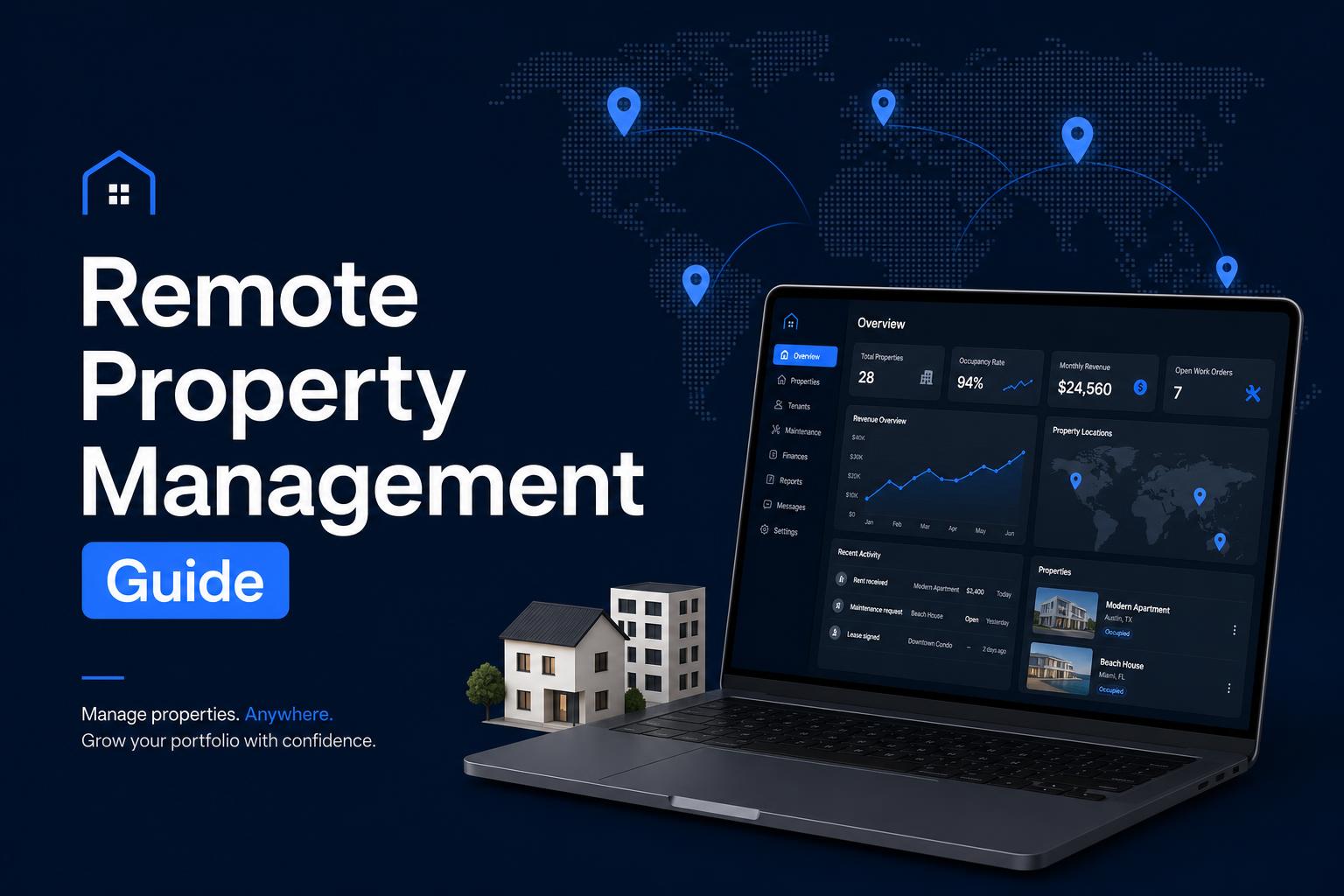
How to Manage Property Remotely: The 2026 Long-Distance Landlord Playbook
Roughly 31% of U.S. single-family rentals are now owned by landlords who live in a different metro than their property (John Burns Research, 2025). A decade ago, "remote landlord" meant "out-of-state investor who shows up once a year." In 2026 it means something very different: operators running 10–200 doors across multiple states from a laptop, with rent collection, leasing, maintenance, and reporting all happening through software and trusted local vendors.
Done well, remote property management is more efficient than local management — fewer drive-bys, fewer drop-in tenant visits, more discipline around process. Done badly, it's a slow leak of margin through delayed maintenance, vacant units no one notices, and tenants who learn that the landlord can't see what's happening.
This guide is the actual operator's playbook: the tools, vendor relationships, workflows, and reporting cadence that make remote management work at 5 doors and at 500.
The Three Things Remote Landlords Actually Need
Strip away the noise and remote property management comes down to three capabilities:
- Eyes on the property when you can't physically be there.
- Hands on the property when something needs fixing.
- Books on the property so cash flow and compliance are never a mystery.
Every tool, vendor, and process discussed below maps to one of these three.
Eyes: Inspections, Monitoring, and Tenant Communication
You cannot manage what you cannot see. Local landlords substitute proximity for process. Remote landlords need actual process.
Quarterly inspections (non-negotiable)
Schedule a paid inspector — not a maintenance tech, not a property manager — to walk every unit once per quarter. Cost: $75–$150 per inspection. Output: photo/video report, condition rating, lease-violation flags (unauthorized pets, smoking, unauthorized occupants, neglect). Companies like RentCheck, zInspector, and many local real-estate inspectors handle this.
A 50-unit portfolio with quarterly inspections runs about $24,000/year. The cost of not doing them — undetected water damage, hoarding, unauthorized pets ruining flooring — averages 2–4× that.
Move-in / move-out documentation
Every move-in and move-out gets a timestamped, geotagged video walkthrough plus a photo checklist of 40+ items. This is the single highest-ROI process in remote management — it eliminates 90%+ of security-deposit disputes and gives small-claims courts unambiguous evidence.
Smart-home telemetry
For higher-value properties (≥$2,500/month rent), water leak sensors, smart thermostats, and entry sensors pay for themselves the first time a sensor catches a slab leak at 3 AM. Budget $200–$400/unit one-time + $5–$10/month per unit. Vendors: Flo by Moen, Honeywell, SmartRent, Latch.
Tenant communication on the tenant's schedule, not yours
Remote landlords lose tenants by being unreachable. Solutions:
- Dedicated tenant portal (NOT your personal email or cell)
- 24/7 maintenance hotline (third-party answering service, typically $0.85–$1.50 per minute)
- AI chatbot for after-hours triage
- Promised response SLAs: 2 hours business, 6 hours overnight, 24 hours weekend
Hands: The Local Vendor Network That Replaces You
This is where most remote landlords fail. You don't need a property manager — you need a vendor stack. Build it deliberately.
The minimum viable vendor stack
| Role | What they do | Hiring criteria |
|---|---|---|
| General handyman | $80–$120 calls, anything ≤$500 | Licensed where required, references, photo-of-work requirement |
| Licensed plumber | Water heaters, leaks, drain clears | After-hours availability, flat-fee pricing |
| Licensed electrician | Panel work, outlets, safety | Same |
| HVAC company | Seasonal service, emergency repair, replacements | Maintenance contract pricing, parts availability |
| Roofer | Leaks, replacements, storm damage | Insurance-claim experience |
| Make-ready / turnover crew | Paint, clean, repairs between tenants | Fixed per-unit pricing |
| Landscaper / snow removal | Curb appeal, liability | Reliable schedule, before/after photos |
| Pest control | Quarterly preventative + incidents | Recurring contract |
| Locksmith | Lockouts, lock changes between tenants | Same-day availability |
| Inspector | Quarterly, move-in/out | Independent of repair vendors (no conflict of interest) |
Rule: redundancy of 2 in every category. The day your only plumber goes on vacation, your second plumber is the one who saves you $4,000 in water damage.
Vendor management hygiene
- Standing W-9 + COI (certificate of insurance) on file. Re-verified annually.
- Photo-of-work requirement for every invoice ≥$200.
- Flat-fee pricing where possible; hourly only for unclear scopes.
- All work-orders flow through your PMS — no text-message dispatch, no email-only.
- Quarterly vendor scorecard: response time, completion %, callback rate, cost variance.
Make-readies: the single biggest hands-on workflow
Standardize turnovers into a fixed scope (paint walls, deep clean, replace toilet seats and shower heads, re-key, smoke detector check, blinds, replace any item rated ≤3/10 in inspection) with a fixed price per bedroom. A predictable $1,200 turnover beats a "we'll see what it costs" $2,700 turnover every time.
Books: Money In, Money Out, Nothing Lost
The third leg is financial. Remote landlords cannot afford "I'll figure it out at year-end."
Required workflows
- Rent collection through tenant portal only. No Venmo, no Zelle, no checks. ACH + card with surcharge.
- Auto-late-fee posting at day 5 (or whatever your lease specifies). Removes the awkward conversation.
- Auto-renewal reminders at 90, 60, 30 days. Vacancy is more expensive than a rent increase you didn't ask for.
- Real-time bookkeeping — every transaction categorized as it happens, not at month-end.
- Owner-style monthly reports even if you are the owner. Forces discipline. See our property management report template.
- Annual 1099s for all vendors paid ≥$600. Don't get caught.
Banking structure for remote portfolios
- One operating account per entity (LLC).
- Separate security deposit trust account (legally required in most states).
- Reserve account (money market, interest-bearing).
- Optional: per-property sub-accounts for high-volume operators.
See our cash flow management for property portfolios guide for the reserve targets and 13-week forecasting framework that pairs with this banking structure.
Choosing Where to Buy When You Live Far Away
The best remote portfolios aren't accidents — they're the result of disciplined market selection. Filters that matter:
- Population growth ≥1.0% over trailing 5 years (US Census).
- Job diversity — no single employer >15% of jobs.
- Landlord-friendly legal environment — short eviction timelines (≤45 days), no rent control, no source-of-income mandates that complicate screening.
- Property tax stability — predictable assessments, no homestead loopholes that punish non-resident owners.
- Strong vendor density — population ≥150,000 in the metro so you have multiple plumbers, HVAC, handymen to choose from.
- Insurance availability — avoid wind/wildfire markets where carriers are exiting unless you can absorb 20% YoY premium growth.
The Remote-Friendly Tech Stack
A 2026 remote operator runs on roughly six tools, all integrated:
- Property management system — leasing, rent, work orders, accounting. Pickspace's AI property management platform is built for multi-state remote operators and consolidates 4–6 legacy tools.
- Smart-home telemetry — leak sensors, locks, thermostats.
- Inspection software — RentCheck, zInspector, or in-PMS inspections.
- Tenant screening — TransUnion SmartMove, Experian RentBureau, or in-PMS.
- E-signature — DocuSign, HelloSign, or in-PMS leases.
- Document storage — Google Drive / Dropbox with strict folder structure per property.
If your PMS covers #1, #3, #4, #5, and #6 natively, you've replaced five tools with one. That's the structural advantage of modern AI-native PMS over legacy stacks.
The Three Failure Modes (and How to Avoid Them)
Failure mode 1: The "I'll handle it myself" trap. You answer maintenance calls at 11 PM. You miss inspections because you're traveling. You're not running a portfolio — you're a 2nd-shift dispatcher who happens to own buildings. Fix: hire a third-party 24/7 maintenance line within the first 25 units.
Failure mode 2: Over-trusting a single property manager. Local PMs can be excellent, but giving any one PM control of your money, your vendors, and your tenant relationships with no auditing is asking to be embezzled or neglected. Fix: independent quarterly inspections + bank access (read-only) + quarterly vendor invoice audits.
Failure mode 3: Letting the books drift. Six months of un-categorized transactions = a 40-hour year-end cleanup project, a stressed CPA, and missed deductions. Fix: PMS-integrated accounting, weekly reconciliation, monthly owner-report habit.
A Day in the Life of a 75-Door Remote Operator
- 8:00 — Open dashboard. Yesterday's collections, today's expected payments, any unit going past 5 days late, any work order ≥48 hours open.
- 8:30 — Approve 3 work-order quotes from vendors. Reject 1, ask for re-bid.
- 9:00 — Review weekly inspection report from RentCheck. One lease violation (unauthorized pet) — automated notice queued.
- 9:30 — Renewal calls scheduled with 4 tenants expiring in 60 days.
- 10:30 — 30-minute call with HVAC vendor about a planned 12-unit furnace replacement program (capex, 18-month timeline).
- 11:00 — Quarterly insurance review with broker; 2 properties up for renewal next month.
- Afternoon — Acquisition diligence on a 12-unit building in a target market.
That's 2–3 hours of operational work per day for 75 doors, when the systems are right. Without systems, the same portfolio consumes a full-time job and underperforms.
Should You Hire a Local Property Manager Anyway?
Sometimes yes. A local PM makes sense when:
- You have ≤8 doors in a single market (vendor stack overhead doesn't pay back).
- The market has unique compliance burden (NYC, SF, Berkeley) you can't credibly absorb.
- You don't want to be the after-hours backstop and aren't large enough for a 24/7 service.
When you grow past 25 doors in a market, a self-managed model with PMS + vendor stack typically beats a 8–10% management fee by 4–6 points of NOI.
The Bottom Line
Remote property management isn't a workaround — for the right operator, it's a competitive advantage. Lower overhead, higher discipline, more markets to choose from, faster scale. The tools are mature in 2026. The vendor networks are denser than ever. What separates the operators who do it well from the ones who quietly lose money is not where they live — it's whether they've built the eyes, hands, and books their portfolio needs.
Case Study: From 12 Doors Local to 84 Doors Across 4 States
A Pickspace customer started as a Phoenix-based landlord with 12 SFR units, all within a 25-minute drive. By 2025 they were running 84 doors across Arizona, Nevada, Tennessee, and North Carolina, all remotely, with a single full-time hire (a maintenance coordinator) and one part-time bookkeeper.
What they built:
- Tennessee market entry first (population growth + landlord-friendly + low entry prices). 18 doors acquired in 14 months.
- Vendor stack ready before close of the first Tennessee property. Three handymen, two plumbers, one HVAC company, one inspection vendor — all interviewed and reference-checked.
- PMS migrated from QuickBooks + Excel to a unified platform before the third market opened. Without this, the operator estimated they would have stalled at ~40 doors.
- Quarterly travel rotation — one market visited each quarter, in-person walk-throughs of every property, dinner with each major vendor.
- 24/7 maintenance answering service activated at door 30.
- Read-only banking access for the bookkeeper and CPA.
Three years in, the portfolio's operating expense ratio (excluding debt service) sits at 32% — competitive with much larger institutional operators — and the owner spends roughly 18 hours/week on the business.
The First Four Markets Most Remote Operators Pick Wrong
Common mistakes when choosing your first remote market:
- Chasing low entry prices in stagnating metros. A $90,000 house in a city losing population is a 15-year liquidity trap, not a deal.
- Buying in your hometown's most-Instagrammed sister market. Austin in 2021. Boise in 2022. Nashville in 2023. By the time you've heard about a market on a podcast, the easy money is gone.
- Entering with a single property in a city. You can't justify the vendor stack overhead for one door. Either commit to 5+ doors over 18 months or don't enter.
- Skipping the legal-environment check. Eviction timelines vary from 21 days (Arkansas) to 9+ months (New York City). A landlord-unfriendly market can wipe out a year of returns on a single non-paying tenant.
Compliance Considerations for Out-of-State Owners
Operating across state lines triggers compliance obligations many landlords miss:
- Foreign LLC registration in every state where you own property (typically $50–$500 + annual fees).
- State income tax filing in every state where rent is collected — even at a loss.
- Local business licenses required in many cities for rental property ownership.
- Trust accounts for security deposits, with state-specific rules (some require interest paid to tenants; some prohibit commingling with operating funds).
- Property manager licensing — if you hire a local manager, they typically need a real estate license; if you self-manage, requirements vary by state.
Always work with a CPA who specializes in multi-state real estate and a local attorney in any new market before close.
The Owner-Operator's Weekly Cadence
A repeatable rhythm beats herculean effort:
- Monday morning — review weekend collections, work-order backlog, vacancy report.
- Monday afternoon — vendor invoice approval queue.
- Tuesday — lease renewals expiring in 60 days; outbound calls.
- Wednesday — inspections report review + lease-violation notices.
- Thursday — acquisition pipeline / property tours / due diligence.
- Friday morning — financial reconciliation (bookkeeper handoff).
- Friday afternoon — strategic / portfolio-level work.
Without a cadence, remote operators end up firefighting whatever shouts loudest. With a cadence, the same portfolio runs in 60–70% less time.
Run This Playbook With Pickspace
Pickspace is the AI-native property management platform U.S. operators use to automate leasing, maintenance, collections, and reporting across residential, commercial, and mixed-use portfolios.
- AI Property Management — automated workflows that replace manual admin work.
- Commercial PMS — CAM reconciliation, escalations, anchor-tenant reporting.
- White-Label PMS — operate under your own brand for owners and partners.
Book a 20-minute demo →
See how Pickspace replaces 4–6 tools and saves operators 12–20 hours per week.
Related reading
- Property Portfolio Cash Flow Management
- Preventative Property Maintenance Guide
- How to Create a Property Management Report
- Real Estate Technology Integration
- AI Property Management Software
Written by the Pickspace Editorial Team — operators, product leaders, and proptech analysts publishing original research on U.S. property management.
See Pickspace in action
Want this in your portfolio? Get a guided 20-minute tour.
Tailored to your property type. No credit card.
Frequently asked questions
Can I really manage rental properties from another state?+
Do I need a local property manager if I live far away?+
How do I find trustworthy vendors in a market I don't live in?+
What's the best software for remote property management?+
How often should I inspect a remotely-managed rental?+
What's the biggest mistake remote landlords make?+
Run your portfolio on Pickspace
Get a personalized walkthrough — built around your property type, your workflows, and your team.
Personalizada para tu tipo de propiedad · Sin tarjeta · 20 minutos