
Real Estate Technology Integration: The 2026 Strategy Guide
How to architect a connected proptech stack — PMS, accounting, payments, smart-home, and AI — without integration debt or data silos.
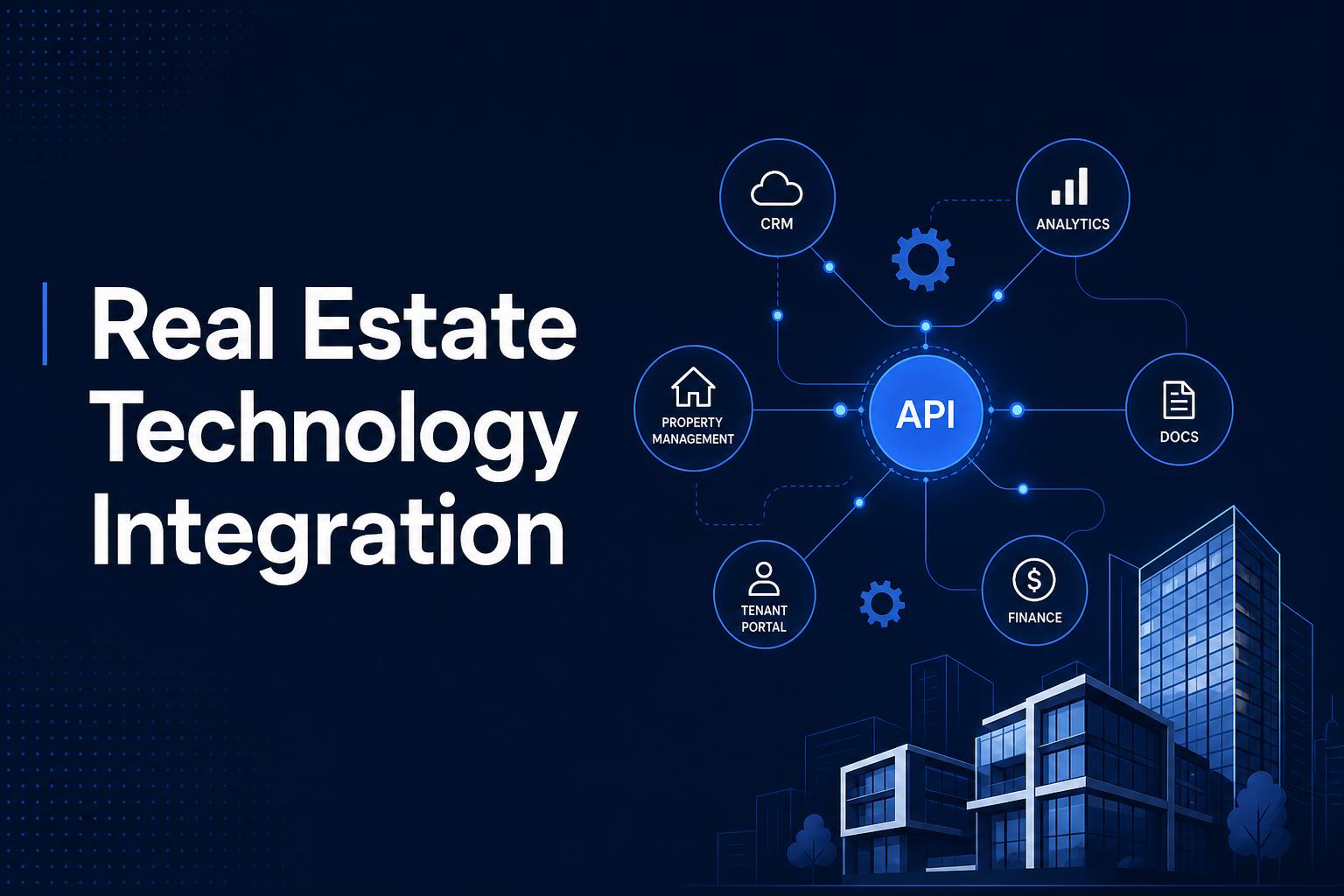
Real Estate Technology Integration: The 2026 Strategy Guide
By 2026, the average mid-sized U.S. property management company runs between 8 and 14 distinct software systems: a property management system, an accounting platform, a tenant screening service, an e-signature tool, a maintenance dispatch app, a smart-home stack, a marketing/ILS feed manager, a CRM, a document storage system, and increasingly an AI assistant or two. Most of them don't talk to each other.
The cost of this fragmentation isn't theoretical. NAA's 2025 Operations Survey put the average mid-sized operator's annual cost of "integration debt" — duplicate data entry, reconciliation errors, missed work orders, delayed reporting — at roughly $1,200 per door per year. For a 500-unit portfolio that's $600,000 annually evaporating into clipboards, spreadsheets, and Slack messages between systems.
Real estate technology integration is the discipline of building a proptech stack where the systems actually communicate, data flows in one direction, and the operator sees a single source of truth. Done right, it doesn't just save money — it unlocks AI workflows, real-time reporting, and operational scale that fragmented stacks can never reach.
This is the strategy guide: how to architect a connected stack, what to integrate first, what to leave alone, and how to avoid the most expensive mistakes.
The Three Layers of a Modern Proptech Stack
Every real estate operation has three software layers, whether the leadership team has named them or not:
Layer 1: The system of record
Where the source of truth lives for each business object:
- Rent ledgers, leases, tenants → PMS
- General ledger, payables → Accounting
- Tenant identity & screening history → PMS or screening vendor
- Owner ledgers → PMS
- Properties, units, floorplans → PMS
Layer 2: The systems of engagement
How tenants, owners, vendors, and staff interact:
- Tenant portal
- Owner portal
- Vendor portal
- Staff mobile app
- AI assistants / chatbots
Layer 3: The systems of intelligence
Where decisions get supported:
- Reporting & BI
- Forecasting & cash flow
- AI summarization & operations
- Anomaly detection & compliance
A clean architecture has one system of record per object, multiple systems of engagement reading from it, and an intelligence layer that pulls from all of them. A broken architecture has three systems claiming to be the source of truth for the same tenant ledger.
The Five Integration Patterns That Actually Matter
You don't need every system to integrate with every other system. You need five patterns to work reliably.
1. PMS ↔ Accounting
The most consequential integration in any portfolio. Required:
- Rent, late fees, deposits posted to GL automatically.
- Payables (work orders, vendor invoices) flow from PMS into accounting with property/unit dimension intact.
- Bank reconciliation in one place.
- Owner statements generated from a single source.
Operators running separate PMS + QuickBooks with manual entry typically lose 8–14 hours/week to reconciliation and report 11–18% higher year-end audit findings than integrated stacks.
2. PMS ↔ Payments
- ACH and card payments post to tenant ledger automatically.
- Failed payments trigger automated retry + notice.
- Vendor payments (ACH or check) flow back into PMS payables.
- 1099 generation pulls directly from PMS vendor records.
3. PMS ↔ Maintenance / Smart-Home
- Work orders created from tenant portal route to vendor with full context.
- Smart-home alerts (water leak, HVAC fault) auto-create work orders.
- Photos, before/after, completion timestamps written back to the unit record.
- Vendor cost flows into PMS payables.
4. PMS ↔ Leasing / Marketing
- ILS feeds (Zillow, Apartments.com, Realtor) pull from PMS unit availability in real time.
- Inquiries flow into PMS CRM.
- Application + screening writes back to PMS as part of the prospect record.
- E-signed lease populates the PMS lease record without re-keying.
5. PMS ↔ Communication
- All tenant communication (SMS, email, in-app) logged against the tenant record.
- Auto-notifications (late rent, lease expiration, scheduled inspection) triggered by PMS events.
- AI assistant has read access to context (lease, ledger, work-order history) when responding.
If those five patterns work, 80%+ of the integration value is captured.
API, Webhook, iPaaS, or Native — Which to Use
Four common integration mechanisms, each with a sweet spot:
| Mechanism | Best for | Risk |
|---|---|---|
| Native (built-in) | Critical paths where data integrity is non-negotiable | Vendor lock-in |
| Public REST API | Custom workflows, internal tools | Maintenance burden |
| Webhooks (event-driven) | Real-time triggers (payment received → notify tenant) | Missed events if endpoint down |
| iPaaS (Zapier, Make, Workato) | Low-volume, low-criticality glue | Latency, brittle on schema changes |
Rule of thumb: never put critical financial data (rent posting, payables, deposits) on Zapier. Use native or direct API. iPaaS is for marketing automation, internal notifications, and ad-hoc bridges between low-risk systems.
The Master Data Question
Every multi-system stack runs into the same problem: which system "owns" a tenant? A unit? A property?
Best-practice answers for 2026 portfolios:
| Object | System of record | Why |
|---|---|---|
| Property / unit | PMS | Lease, rent, occupancy all live here |
| Tenant identity | PMS | Including screening history |
| Lease | PMS | Source of truth for ledger, rent, term |
| Vendor | PMS or accounting (pick one) | Pick one to avoid duplicate W-9s and 1099 errors |
| Owner | PMS | Statements, distributions, communications |
| GL accounts | Accounting | Chart of accounts, tax categorization |
| Payments | PMS (operational) + bank (reconciliation) | PMS records, bank confirms |
Make these explicit on a one-page architecture diagram. Operators without one debate the same "where does this live" questions for years.
Where AI Fits — and Where It Doesn't
In 2026, AI integration is the highest-leverage layer for operators who get the foundation right. The four areas where AI is delivering material ROI:
- Tenant communication triage — chatbots handling 60–80% of routine inquiries (rent date, lease question, simple maintenance) with seamless human handoff for the rest.
- Work order categorization & dispatch — natural-language tenant complaints turned into structured work orders, routed to the right vendor with priority assignment.
- Lease abstraction — commercial lease PDFs converted into structured data (key dates, escalations, options, CAM) in seconds.
- Reporting summarization — monthly operating reports auto-summarized in plain English for owners.
AI works only when the foundation systems are integrated. An AI assistant that can't read the tenant ledger, can't see the work-order history, and can't update the PMS is a glorified FAQ page. Pickspace's AI property management platform is built around this principle — AI workflows sit on top of unified data, not bolted onto fragmented systems.
Integration Anti-Patterns (Stop Doing These)
- CSV exports between systems. Manual, error-prone, no audit trail. If a vendor only offers CSV, push back hard or replace them.
- Email-as-API. "We email a report nightly and someone uploads it." That someone forgets, gets sick, or quits.
- Custom point-to-point integrations between every pair of systems. N systems = N² integrations. Use a hub (your PMS) as the spine.
- Letting power users build the integration themselves. A leasing manager who builds a Zapier scenario that handles rent posting is a single point of failure with no documentation.
- Integrating before standardizing data. If property names are inconsistent ("Maple St", "123 Maple", "Maple Apartments"), no integration will work. Clean master data first.
Build vs. Buy vs. Replace
When facing an integration problem, three options:
- Build a custom integration — only when no vendor offers it and the workflow is a real competitive differentiator.
- Buy a connector or iPaaS recipe — for low-criticality, well-defined glue (e.g., lead from Zapier into CRM).
- Replace one system — frequently the right answer in 2026. A modern unified PMS that natively handles accounting, payments, maintenance, leasing, and reporting often eliminates 4–6 integration projects entirely.
The math usually favors replacement past a certain stack-fragmentation threshold. Operators running PMS + separate accounting + separate work-order app + separate screening + separate e-sign + separate ILS manager + separate reporting tool typically pay more in software + integration cost than a unified modern PMS would charge in total.
See our benefits of property management software guide for the consolidation math, and the commercial real estate PMS overview for how this plays out at scale.
Security & Compliance in an Integrated Stack
More integrations = more attack surface. Non-negotiable controls:
- SSO across all systems (SAML or OIDC). No more individual logins.
- Role-based access control mapped consistently across systems.
- API key vaulting — never store keys in code or shared docs. Use a secrets manager.
- Audit logging on every system touching tenant PII or payments.
- PCI-DSS compliance on the payments path. Don't store card numbers; let the processor do it.
- SOC 2 Type II vendors for any system holding sensitive data. Ask for the report.
- Tenant data minimization — only sync what each downstream system actually needs.
The 90-Day Integration Roadmap
Days 1–30: Inventory & diagnose
- List every system in use. Who pays, who owns, what data flows where.
- Draw the master-data map.
- Identify the 3 most-painful manual handoffs.
- Score each system on data-quality and integration maturity.
Days 31–60: Stabilize the spine
- PMS ↔ Accounting integration must work reliably. If it doesn't, fix it before anything else.
- Set up tenant-facing communication logging.
- Consolidate or kill duplicate systems (multiple work-order apps, multiple CRMs).
Days 61–90: Add intelligence
- Connect smart-home alerts to work-order creation.
- Enable AI tenant communication triage.
- Build a single executive dashboard pulling from the integrated stack.
Operators following this roadmap typically reclaim 10–18 hours/week of staff time and reduce data-quality incidents 60%+ within one quarter.
The Bottom Line
Real estate technology integration isn't a project — it's an ongoing discipline. The operators outperforming peers in 2026 don't have more software; they have more coherent software. A unified PMS as the spine, deliberate integrations to specialty systems, master data discipline, and AI layered on top of real-time unified data. That stack runs lighter, scales faster, and lets the operator focus on operating instead of reconciling.
Case Study: A 380-Unit Operator Replaces 7 Tools With 2
A regional Pickspace customer operating 380 units across Florida and Georgia entered 2024 running a stack of:
- Buildium (PMS)
- QuickBooks Online (accounting, manually reconciled)
- AppFolio Stack (marketing/ILS feeds)
- Latchel (work order dispatch)
- TransUnion SmartMove (screening)
- DocuSign (e-signature)
- Google Drive (document storage)
- A custom Zapier mesh of ~14 workflows holding it together
Total annual software cost: ~$62,000. Estimated annual cost of integration debt (manual reconciliation, missed work orders, late owner reports, duplicate vendor records): ~$310,000.
The replacement project replaced #1 through #6 with Pickspace's unified PMS, kept QuickBooks for tax-specific GL reporting (now native-integrated), and kept Google Drive for non-operational documents. The Zapier mesh was decommissioned.
Results at 9 months post-cutover:
- Software cost: $62,000 → $44,000 annual.
- Manual reconciliation time: 18 hours/week → 3 hours/week.
- Average work-order turnaround: 6.4 days → 2.1 days.
- Owner report delivery: 12 days post month-end → 3 days.
- Year-end audit findings: down 71%.
- Tenant NPS: +14 points.
The pre-migration team estimated the cutover would take 4 months. It took 7. The vast majority of the extra time was data cleanup — duplicate vendor records, inconsistent property naming, orphaned tenant entries — work that should have been done years earlier independent of any migration.
The Integration Maturity Model
Where does your stack actually sit? Five levels:
| Level | Description | Typical operator |
|---|---|---|
| 1. Manual | CSV exports, paper, spreadsheets | <50 doors, paper-era operators |
| 2. Connected | iPaaS or basic API connections, mostly batched | 50–200 doors using legacy PMS |
| 3. Unified PMS | One PMS as system of record, native modules | 200–1,500 doors on modern PMS |
| 4. AI-augmented | Unified PMS + AI workflows on top | Early adopters, 2025+ |
| 5. Composable | Custom workflows + AI agents acting on unified data | Institutional / large operators, late 2026+ |
Most U.S. operators in 2026 are at level 2 or 3. The biggest jump in operating efficiency happens between levels 2 and 3 — typically 25–40% reduction in operations labor per door.
Integration Governance: The Boring Stuff That Matters
For operators above 300 doors, integration governance is no longer optional:
- A single owner of each integration (named person, not a team).
- Documented data flow diagrams kept current.
- Quarterly integration health reviews — error rates, latency, data quality.
- Change management process when any system in the stack updates its API.
- Vendor SLA tracking for uptime and support response.
Operators without governance discover their integrations are broken when a tenant complains. Operators with governance find out from monitoring before tenants notice.
What's Coming Next in Real Estate Integration
Three trends shaping 2026–2027 stacks:
- AI agents as integration glue. Instead of webhooks and API calls, AI agents that can read multiple systems' data and take actions across them — handling routine tenant requests, scheduling vendors, generating owner updates — without explicit integration code for every workflow.
- Open banking + accounting consolidation. PMS platforms with native banking integration eliminate the QuickBooks-as-secondary-ledger pattern entirely.
- Tenant identity portability. Tenant credit, screening, and rental-history data becoming portable across PMS platforms via standardized APIs.
Operators choosing PMS in 2026 should weight openness to these trends heavily. A platform that can't add AI workflows or doesn't expose APIs will be a constraint by 2028.
Run This Playbook With Pickspace
Pickspace is the AI-native property management platform U.S. operators use to automate leasing, maintenance, collections, and reporting across residential, commercial, and mixed-use portfolios.
- AI Property Management — automated workflows that replace manual admin work.
- Commercial PMS — CAM reconciliation, escalations, anchor-tenant reporting.
- White-Label PMS — operate under your own brand for owners and partners.
Book a 20-minute demo →
See how Pickspace replaces 4–6 tools and saves operators 12–20 hours per week.
Related reading
- Benefits of Property Management Software
- Property Portfolio Cash Flow Management
- Remote Property Management Guide
- How to Create a Property Management Report
- Commercial Real Estate PMS
- AI Property Management Software
Written by the Pickspace Editorial Team — operators, product leaders, and proptech analysts publishing original research on U.S. property management.
See Pickspace in action
Want this in your portfolio? Get a guided 20-minute tour.
Tailored to your property type. No credit card.
Frequently asked questions
What is real estate technology integration?+
What proptech systems should always integrate with my PMS?+
Should I integrate my systems or replace them with one platform?+
How much does proptech integration cost?+
Is Zapier safe for property management workflows?+
How long does a proptech integration project take?+
Run your portfolio on Pickspace
Get a personalized walkthrough — built around your property type, your workflows, and your team.
Personalizada para tu tipo de propiedad · Sin tarjeta · 20 minutos