
Co-Living Property Management: The 2026 Operator's Playbook
What co-living is, why it works, and how property managers should structure leases, price rooms, and operate shared-living buildings in 2026.
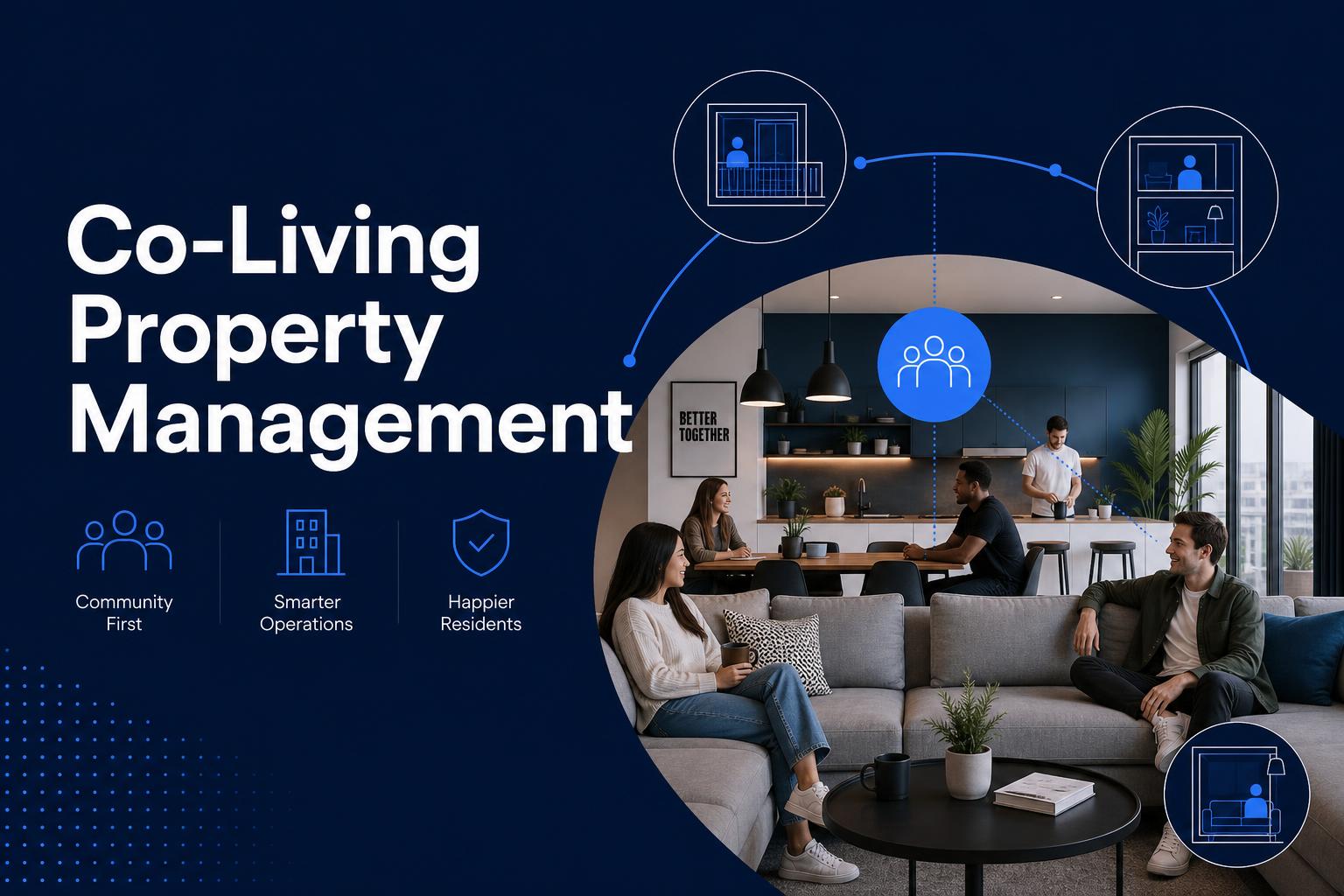
Co-Living Property Management: The 2026 Operator's Playbook
Co-living — purpose-built shared housing where tenants rent a private bedroom and share common spaces — has matured from a coastal-millennial experiment into a real asset class. U.S. co-living inventory grew from ~14,000 beds in 2018 to an estimated 78,000 in 2025 (CBRE Multifamily Research), with the strongest growth in secondary markets where conventional one-bedrooms now exceed $2,400/month.
For property managers, co-living is neither a gimmick nor a magic bullet. It's a distinct operating model with its own leasing structure, maintenance pattern, tenant profile, and software requirements. Operators who treat a co-living building like a furnished apartment building lose money. Operators who treat it as the hospitality-meets-housing hybrid it actually is can produce 18–32% higher revenue per square foot than conventional multifamily — but with materially more operational complexity.
This guide is the practical playbook: lease structures, pricing, operations, software, and the tradeoffs every operator should understand before adding co-living to a portfolio.
What Co-Living Actually Is (and Isn't)
Co-living buildings come in three structural variants:
- Converted shared apartments — a 3- or 4-bedroom unit leased by the room to unrelated adults. Cheapest to convert, easiest to operate, but legally tricky in cities with occupancy limits.
- Purpose-built co-living buildings — every "unit" is a private bedroom + bath, with shared kitchen, lounge, gym, coworking, and laundry. Common in cities with high land cost (SF, NYC, LA, Austin, Miami).
- Hybrid micro-unit + amenity buildings — small private studios (200–350 sqft) with extensive shared amenity space. Operates more like an aparthotel.
Co-living is not a hostel, not a short-term rental, and not student housing — though it borrows operational DNA from all three. Lease terms are typically 3–12 months, residents are typically 24–34 years old, professionally employed, and increasingly include remote workers who travel between cities.
The Economics: Why Operators Build Co-Living
Co-living's value proposition for owners is revenue per square foot. A conventional 1,000 sqft two-bedroom in Austin might rent for $2,300 ($2.30/sqft). The same footprint as a 4-bedroom co-living configuration with shared kitchen/living rents at $950/bedroom × 4 = $3,800 ($3.80/sqft) — a 65% lift in gross revenue per square foot.
But:
- Vacancy is room-by-room, not unit-by-unit. A 4-bedroom co-living unit with 1 vacancy is at 75% occupancy on that unit.
- Turnover is materially higher. Average length of stay: 8–11 months vs. 22 months for conventional multifamily.
- Operating expenses are higher — furnished spaces, utilities included, more cleaning, more management overhead per dollar of rent.
- CAM and shared-space wear are constant capex items.
When you net it out, well-run co-living typically produces 15–25% higher NOI per square foot than conventional multifamily — meaningful, but not the "double the revenue" some operators imagine.
Lease Structures: Choose Carefully
This is the single most consequential operational decision in co-living. Three models:
Model 1: Joint lease (all roommates on one lease)
- Tenants are jointly and severally liable.
- Operationally simple — one lease, one rent payment expected.
- Bad for true co-living. Strangers won't sign joint leases. Renewal cycle breaks when one roommate leaves.
Model 2: Individual room lease (preferred)
- Each tenant signs a lease for their bedroom + shared use of common areas.
- Operator selects roommates, manages turnover room by room.
- Higher admin overhead, but the only model that supports actual stranger-to-stranger co-living.
- Requires PMS support for sub-unit leasing (most legacy PMS don't have this).
Model 3: Membership / subscription model
- All-inclusive monthly fee, often with flexibility to move between buildings in a network.
- Operationally complex but maximizes lifetime value.
- Used by branded co-living operators (Common, Outpost Club, X Social Communities).
For most operators converting existing inventory, Model 2 (individual room leases) is the right answer. It requires PMS infrastructure that treats a bedroom as the leasable unit, with shared-space allocation, utility split logic, and roommate-matching workflows.
Pricing Strategy
Co-living pricing isn't "apartment rent ÷ bedrooms." It's a hospitality-style yield model:
- Base rent per room set against comparable studio + 1-bedroom prices in the submarket.
- Premium for larger rooms, en-suite bathrooms, balconies, better views (typically +$50–$250).
- All-inclusive vs. plus utilities. All-inclusive is the market standard and the right move — your tenants are paying for simplicity.
- Furnished premium — typically +$150–$300/month over unfurnished equivalent.
- Length-of-stay discount — 9- and 12-month commitments at 5–10% off month-to-month rates.
Yield management matters: a 50-bed building with 4 vacancies should drop list price 5–8% for 30 days before holding firm. Static pricing leaves money on the table both ways.
Operations: Where Co-Living Lives or Dies
Roommate matching
The #1 driver of length of stay. Use a structured intake (sleep schedule, work-from-home frequency, cleanliness expectations, pet tolerance, smoking, noise) and match deliberately. Buildings that randomize assignments see 30%+ higher turnover.
Common-area maintenance
Shared kitchens, lounges, laundry rooms wear 3–5× faster than equivalent private spaces. Budget accordingly:
- Weekly professional cleaning of common areas (non-negotiable).
- Quarterly deep clean.
- Refurbishment cycle on shared furniture: 36–48 months (vs. 7–10 years for private rentals).
- A formal "common-area condition" inspection monthly.
Conflict mediation
This is the work nobody warns you about. Noise, dishes, guests, thermostat settings. Successful operators have:
- Clear house rules embedded in the lease.
- A documented escalation process (warning → mediation → lease cure → termination).
- A single point of contact (community manager or AI-mediated portal) for complaints.
- Zero-tolerance items (violence, harassment, illegal activity) defined in writing.
Furnishings and FF&E
Standardize. Don't custom-furnish every room. Operators using IKEA Business or West Elm Workspace contract pricing typically furnish a 4-bedroom unit for $7,500–$11,000 with a 4-year replacement cycle.
Cleaning operations
Most successful co-living operators include common-area cleaning in rent but charge a one-time deep-clean fee at move-out. Some include private-room cleaning monthly as an upsell ($60–$120/month) — high-margin and increases length of stay.
The Technology Stack
Legacy property management systems generally do not support co-living. The functionality you need:
- Sub-unit (bedroom-level) leasing
- Roommate matching and history
- Shared utility allocation
- Common-area work-order routing
- Roommate-specific tenant portal (each tenant sees their own ledger, not the whole unit's)
- Yield-managed pricing room-by-room
- Community announcements + house rules built into the tenant portal
Modern AI-native PMS platforms — including Pickspace's AI property management platform — handle these workflows natively. Trying to retrofit Buildium or Yardi Breeze for co-living typically requires manual workarounds that break at scale.
For larger purpose-built buildings, integrate with smart-lock, access-control, and amenity-booking systems (Latch, SmartRent, Amenify). See our real estate technology integration guide for the integration framework.
Marketing Co-Living: Different From Multifamily
Conventional ILS feeds (Zillow Rentals, Apartments.com) work poorly for co-living because the rental unit is a bedroom, not an apartment. The channels that actually drive bookings:
- Direct website with strong photography of common areas + sample rooms.
- SpareRoom, Roomster — the dominant U.S. shared-housing platforms.
- Furnished Finder for traveling professionals (especially traveling nurses).
- Instagram + TikTok showing community life. Critical for buildings targeting Gen Z and young millennials.
- Corporate housing partnerships — short-term relocation packages.
Average cost per signed lease for co-living is $180–$350, materially higher than conventional multifamily — but the longer-term operators recoup it through length of stay and ancillary revenue.
Compliance and Legal Risks to Manage
Co-living lives in a regulatory gray zone in many jurisdictions:
- Occupancy limits — most cities cap unrelated adults per dwelling unit (often 3–5). Violating this can trigger zoning enforcement and lease unenforceability.
- Boarding house licensing — some jurisdictions classify co-living as a boarding house requiring special permits.
- Fair housing — roommate matching cannot use protected categories (race, religion, national origin, familial status, etc.). "Sleep schedule" and "work-from-home" are safe; "must be female" is generally not, with very limited exceptions.
- Short-term rental rules — many cities now restrict stays under 30 days, which doesn't apply to most co-living but matters for the membership model.
- Insurance — standard landlord policies often exclude shared housing. Get a specialty co-living policy and an umbrella.
Always run any co-living conversion past local counsel before signing leases.
Should You Add Co-Living to Your Portfolio?
Co-living works well when you have:
- A property in a high-rent market where single-tenant pricing has plateaued.
- Bedrooms that are physically separable with reasonable layouts (no walk-throughs).
- Operational appetite for higher-touch management.
- A PMS that supports it.
Co-living works poorly when you have:
- Rural or low-density markets where shared-housing demand is thin.
- Properties with shared bathrooms (acceptable to a much smaller pool of tenants).
- A management team allergic to community-style operations.
- Strict municipal occupancy or zoning constraints.
The Bottom Line
Co-living is not a hack — it's a legitimate operating model that produces real NOI uplift in the right markets and the right buildings. The operators who win treat it as a hospitality-housing hybrid: deliberate roommate selection, standardized furnishings, yield-managed pricing, and software that natively handles bedroom-level leasing. The operators who lose treat it as "regular multifamily with more tenants." The difference between the two is everything.
Case Study: A 6-Bedroom Austin Co-Living Conversion
A Pickspace customer in Austin acquired a 1996-built 4,200 sqft single-family home in a walkable neighborhood for $815,000. As a conventional rental it would have leased for ~$4,200/month — a sub-6% gross yield in that submarket, barely covering carrying costs after taxes and insurance.
Converted to a 6-bedroom co-living configuration (4 existing bedrooms + 2 created from the formal dining and home office), with:
- Each bedroom averaging 11 × 13 ft, private with locks.
- 3 full bathrooms (one added in conversion, $42,000).
- Shared kitchen, living, laundry, backyard, parking for 4 cars.
- Fully furnished common areas + bedrooms.
- All utilities, Wi-Fi, weekly common-area cleaning included in rent.
Cost of conversion: $118,000 (bathroom, partition walls, furnishings, smart locks, sensors, signage, marketing setup).
Operating results year 1:
- Average per-bedroom rent: $1,295/month (range $1,150–$1,475 by room size).
- Average occupancy: 5.4 of 6 beds (90%).
- Effective monthly revenue: ~$6,995.
- Operating cost (utilities, cleaning, internet, repairs, FF&E reserve): ~$1,650/month.
- Net cash flow: ~$5,345/month — vs. ~$3,400 expected from conventional single-tenant rental.
Net NOI uplift of ~$23,000/year on a $118,000 conversion cost. Payback ~5.1 years, with the residual asset still operating as a higher-yielding co-living property indefinitely.
Caveats: Austin allows up to 6 unrelated adults per dwelling in most zones (the operator confirmed before purchase). The same conversion in a city with a 3-unrelated-adult cap would be illegal and uninsurable.
The Hardest Part Isn't What You Think
Operators consistently report that the most challenging part of co-living isn't the lease structure, the furnishings, or even the cleaning — it's emotional labor. Mediating roommate conflicts. Holding boundaries with residents who treat the operator like a parent or a therapist. Removing residents who become disruptive without triggering retaliation or fair-housing claims.
Three operator habits that protect against burnout:
- A formal community manager role at 30+ beds. Not "the owner's cell phone."
- A documented house-rules + escalation policy signed at move-in.
- A no-exceptions removal protocol for safety-related violations.
The Math on Furnishings vs. Unfurnished
Some operators experiment with unfurnished co-living to reduce capex and FF&E replacement cycles. The data is mostly against this:
- Unfurnished co-living rooms rent 11–18% lower than furnished equivalents.
- Average length of stay drops 22% (tenants commit less when they had to move furniture in).
- Turnover damage to common spaces increases (more move-ins = more wall scuffs, more door damage).
Unfurnished can work for premium long-stay buildings targeting 18+ month leases. For typical 6–12 month co-living, furnished wins on every operating metric.
Tax and Insurance Notes Specific to Co-Living
- Insurance: standard landlord (DP-3) policies often exclude buildings with 4+ unrelated occupants. Use a specialty co-living or boarding-house policy. Expect premium ~30–50% higher than equivalent SFR coverage.
- Tax: furnished short-medium-term housing may qualify for accelerated depreciation on FF&E (5- or 7-year MACRS). Work with a CPA familiar with hospitality-residential hybrids.
- Sales/transient occupancy tax may apply if any leases are under 30 days. Most co-living avoids this by setting 30+ day minimums.
Run This Playbook With Pickspace
Pickspace is the AI-native property management platform U.S. operators use to automate leasing, maintenance, collections, and reporting across residential, commercial, and mixed-use portfolios.
- AI Property Management — automated workflows that replace manual admin work.
- Commercial PMS — CAM reconciliation, escalations, anchor-tenant reporting.
- White-Label PMS — operate under your own brand for owners and partners.
Book a 20-minute demo →
See how Pickspace replaces 4–6 tools and saves operators 12–20 hours per week.
Related reading
- Property Management Legal Compliance Guide
- Reduce Rental Vacancy Rates
- Property Portfolio Cash Flow Management
- Real Estate Technology Integration
- AI Property Management Software
Written by the Pickspace Editorial Team — operators, product leaders, and proptech analysts publishing original research on U.S. property management.
See Pickspace in action
Want this in your portfolio? Get a guided 20-minute tour.
Tailored to your property type. No credit card.
Frequently asked questions
What is co-living property management?+
How is co-living different from a regular rental property?+
Is co-living profitable for landlords?+
What software do I need to manage a co-living property?+
What are the biggest challenges of managing a co-living property?+
Is co-living legal everywhere?+
Run your portfolio on Pickspace
Get a personalized walkthrough — built around your property type, your workflows, and your team.
Personnalisée à votre type de bien • Sans carte bancaire • 20 minutes